HEAL TOXIC SHAME
The Inner Critic Does Not Start in Your Head. It Starts in Your Body.
The harsh voice inside is the sound of toxic shame: a state the nervous system learned in childhood and still carries. This page explains how it forms, and why understanding it has not switched it off.
WHAT THE INNER CRITIC IS
The inner critic is the voice inside that judges, warns and attacks. It comments on what we do, how we look, what we say. Most of the time it is against us.
It is convincing because it sounds like our own voice. It knows our history, so it knows exactly where it hurts. And it is never satisfied: fix one thing, and it finds the next.
It is not always loud. Often it works quietly, and passes for personality:
apologising before speaking,
starting with "this is probably stupid, but",
brushing off praise: "they're just being nice",
feeling guilty when resting,
shrinking right after something goes well.
The critic speaks most at the moments that matter: after a success, a risk, or a moment of being seen.
THE VOICE AND WHAT IS UNDERNEATH IT
Most approaches treat the inner critic as a thinking problem. Change the thoughts, and the voice will change. For many people, it does not.
That is because the voice is only the top layer. Underneath it is toxic shame. And toxic shame is not a thought. It is a state of the body.
To understand the inner critic, we have to start with the nervous system.
"The voice is only the top layer. The shame underneath lives in the body."
WHERE THE VOICE COMES FROM
The nervous system's first job is to keep us alive. When it senses danger, it has three answers.
Fight: push back, say no, protect.
Flight: get away.
Freeze: when fighting and running are not possible, the body shuts down. It goes still, small and quiet. Breath gets shallow. Energy drops.
Freeze is the last option, and it is a smart one. It protects us when nothing else can.
Step One ・ A Shamed Child
Toxic shame starts in relationship, with someone who has power over us. Most often a parent. Sometimes an older sibling, a teacher, a bully.
When a child is humiliated, mocked or made to feel worthless, again and again, the body wants to fight back. That is the healthy response. But a child cannot fight the person they depend on to survive. Fighting back gets punished. Running is impossible.
So the nervous system chooses freeze. The child goes small, goes quiet, stops their own energy. The fight is not gone. It is stopped halfway, and held down in the body.
Most parents who do this do not know they are doing it. They carry their own unhealed shame, and pass it on the way it was passed to them. This is how toxic shame moves through generations.
Step Two ・ The Imprint
When this happens once, the body can recover. When it happens again and again, the body stops recovering. Freeze becomes the normal state.
Over time, the shaming words and the energy behind them sink in. A child who keeps hearing "you're too much" or "what's wrong with you?" does not only remember the words. The body takes them in: in the breath, the posture, the gut, the muscles, how much energy is available, how much space the body allows itself to take.
This is what we call an imprint. It is not a memory in the mind. It is a pattern held in the body, below thought.
Step Three ・ What Toxic Shame Really Is
This imprint is toxic shame.
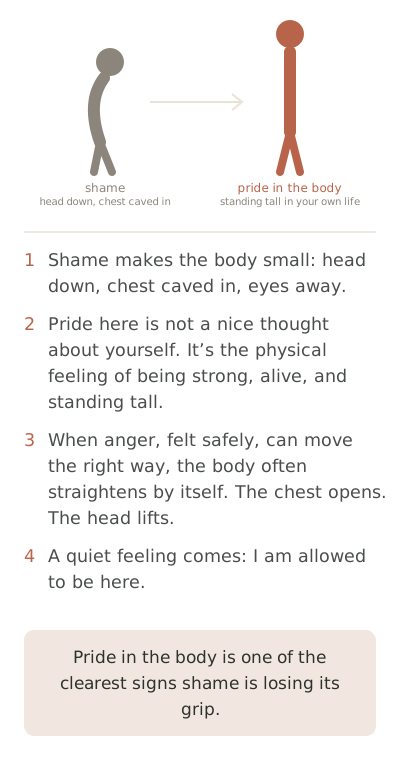
Toxic shame is not really an emotion. It is the body's way of giving up. It drains a person's life force, little by little. The body learns to make itself small, to need less, to take up less room.
It is the body turned against itself. The message it carries is simple and total: "I am bad. I am wrong. Something in me is broken."
This is different from healthy shame. Healthy shame says "I did something wrong," and passes once we repair it. Toxic shame says "I am wrong," and does not pass, because it is not about an event. It is about who we feel we are.
"The force that was meant to protect us turns around and attacks us."
HOW THE INNER CRITIC IS BORN
Two things happen at once.
The fight energy turns inward. The force that should have said "no" to the person who shamed us is still in the body, held down by the freeze. It has nowhere to go, so it turns around and points at the self. What was meant to protect us now attacks us.
The brain explains the body. The brain is always reading signals from the body. When it feels that state of giving up, it looks for a reason, and puts it into words. "You're not good enough." "You'll mess it up." "Who do you think you are?"
Those words are the inner critic. The critic is the body's own fight energy, turned back on the person, speaking with the words and the tone of the people who once shamed them. The person who did the shaming may be long gone. The body learned to carry on the job.
An example. Someone makes a small mistake at work. First the body reacts: heat in the face, a sinking in the belly, a wish to disappear. A moment later the voice comes: "Typical. You always mess up." The body went first. The voice followed, with the same tone a parent once used.
"The body goes first. The voice follows."
THE LOOP THAT KEEPS IT GOING
The inner critic and toxic shame feed each other.
The body drops into shame. The critic puts it into words. The words create more shame. The body drops further. Each turn of the loop makes the next one feel more true.
You get praise. The critic: "They're just being nice." Underneath: I'm not really worth it.
You share an opinion. The critic: "Why did you say that?" Underneath: being seen is dangerous.
You make a small mistake. The critic: "Typical. You always mess up." Underneath: I am the mistake.
You need something. The critic: "Don't be needy." Underneath: my needs are too much.
You rest. The critic: "Lazy." Underneath: I'm only worth what I produce.
Left alone, the loop spreads into a whole life: self-sabotage, low energy, boundaries that are hard to hold, relationships and jobs that repeat the old pattern. Toxic shame tends to attract more shame. It can also sit underneath long-term low mood and depression, because a body that has held down its own force for years has very little energy left.
WHY WORDS DO NOT REACH IT
The body reacts in a fraction of a second, before thinking has started. By the time the voice speaks, the body has already dropped into shame.
This is why arguing with the critic does not work. It is why affirmations, journaling and positive thinking do not last. It is why years of understanding where the voice came from have not switched it off. All of these work on the words. The shame sits underneath, in the nervous system.
Shame was learned by the body, before words. It has to change in the body too.
WHERE CHANGE HAPPENS
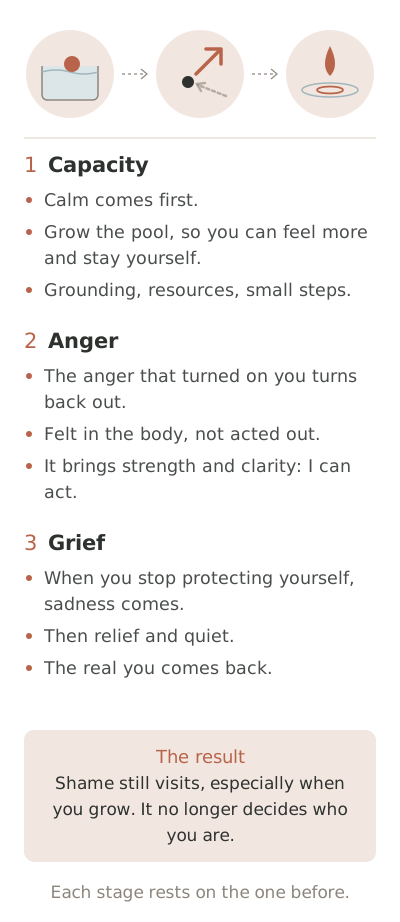
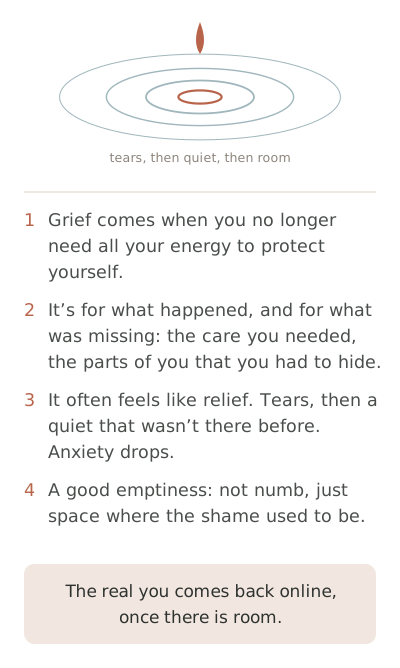
If toxic shame is fight energy that was held down, then the way out is to let that energy come back, slowly and safely.
What heals toxic shame is healthy anger: the natural force that says "no," "stop," "I matter," "I have the right to be here." It is not rage, and it is not acting out. It is the strength that was never allowed.
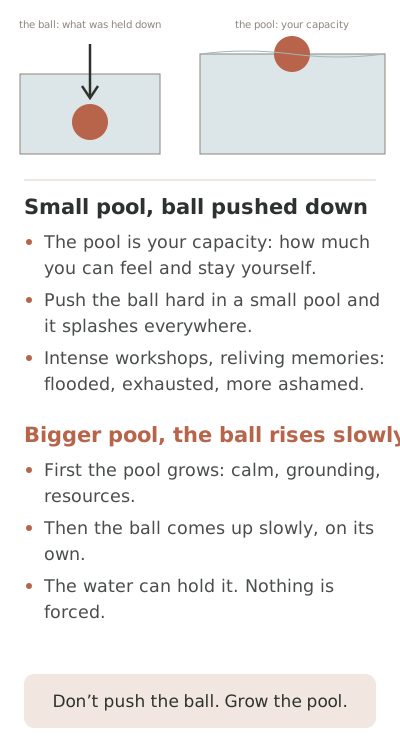
This cannot be rushed. A body that has spent years in freeze first needs the capacity to feel: to notice sensation, to stay present, to hold strong feelings without being overwhelmed. Only then can the held-back energy be felt in small doses and turned back outward.
When that happens, the voice loses its fuel. Not because it was argued with, but because the force behind it has gone back where it belongs.
WHO IS WRITING THIS
I'm Matteo Morozzo, a Somatic Experiencing Practitioner. I know this voice from the inside.
Mine said "I hate you," and it said it for thirty-five years. Therapy and years of spiritual work did not reach it. Working with my nervous system did.

START WITH THE BOOK
Healing Toxic Shame is a free book. Where shame comes from,
why understanding it wasn't enough, and what changes when you
work with your nervous system.
Free. It arrives in your inbox.
THE NEXT STEP
The next step is a First Session: 75 minutes of real somatic work, taken off your package if you continue.

HEAL TOXIC SHAME


© 2026 Matteo Morozzo · healtoxicshame.com