HEAL TOXIC SHAME
Still Hearing Your Inner Critic After All the Inner Work?
MATTEO MOROZZO ・ SOMATIC EXPERIENCING PRACTITIONER

The Feeling That Something Is Wrong
With You
Sometimes there's no reason for it. Nothing went wrong today. Maybe you got
good news. Maybe you spent time with people you love. And still, deep down,
there's a feeling: I am wrong. I am not okay.
Without knowing it, you can build a whole life to keep that feeling away. You work
hard, help everyone, try to be perfect. Or you stop trying. Or you read everyone
else so well there's no room left for you.
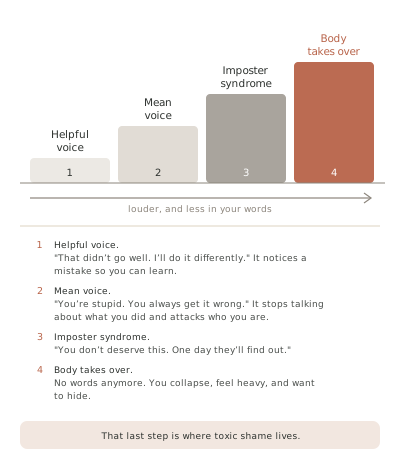
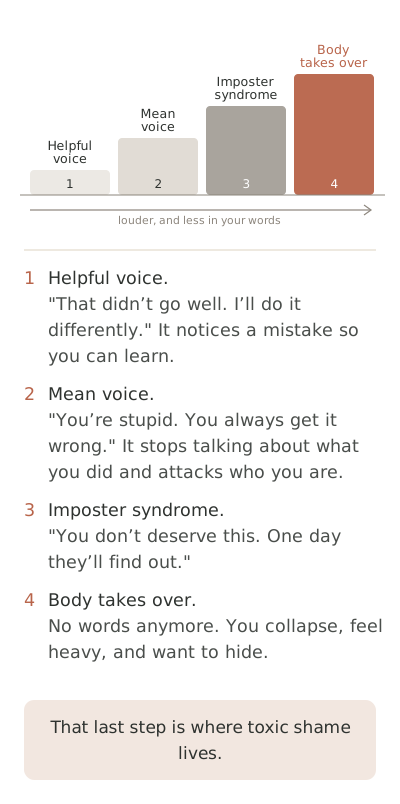
Everyone has a voice inside that judges them. It goes from small to big, like a
ladder. At the top, the voice isn't even needed anymore. The body takes over.
"If they really knew me, they would leave"
WHAT IS TOXIC SHAME?
Normal shame is a signal. It tells you that you crossed a line, so you can say sorry
and fix it. Then it goes.
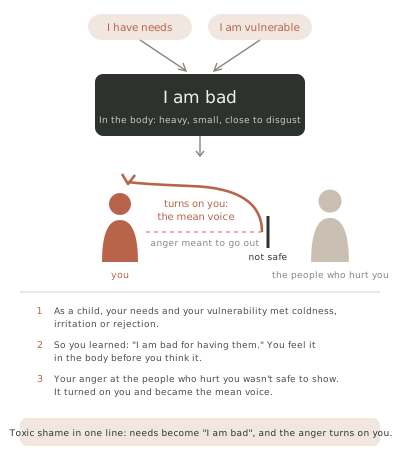
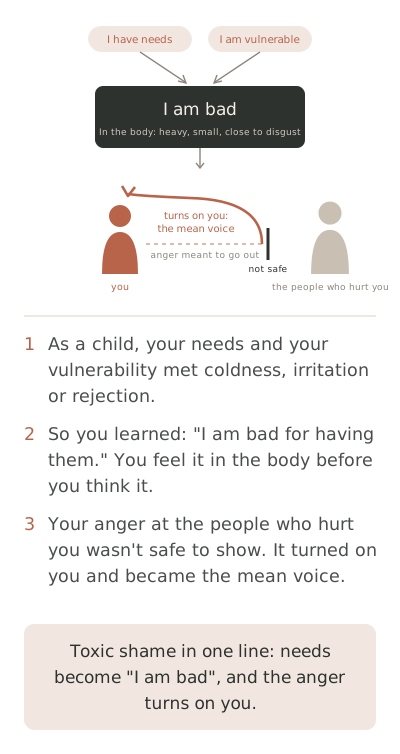
Toxic shame is different. It isn't about something you did. It's about who you are.
At its core, toxic shame says: I am bad. It starts in childhood, when a child learns:
my needs are bad, so I am bad. The anger it can't show turns inward. That's the
mean voice.
TOXIC SHAME IN THE BODY
Toxic shame isn't really a thought. It's a gut feeling. The whole body drops into it:
heavy, tired, small, wanting to disappear. And it arrives before any thought,
which is why arguing with it doesn't work.
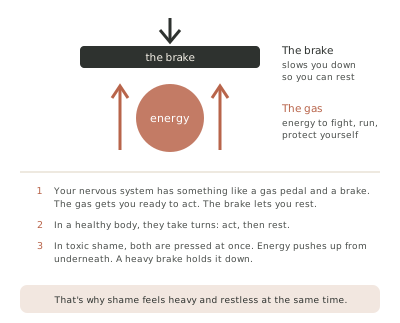
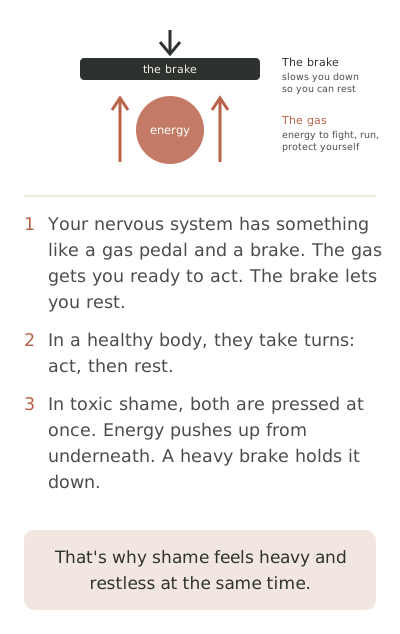
Your nervous system has something like a gas pedal and a brake.
In toxic shame, both are pressed at the same time.
This is good news, even if it doesn't feel like it. Toxic shame isn't the bottom. Under
it are healthy feelings that are still alive.
WHERE TOXIC SHAME COMES FROM
A child can't survive alone. When its needs and feelings are treated again
and again as the problem, the child learns: this feeling makes me bad.
Shame is also one of the fastest ways to control a child. A cold look. "Stop crying."
"Don't be so weak." The behavior stops. The shame stays. After a while, the child
doesn't need anyone to shame them. They do it to themselves.
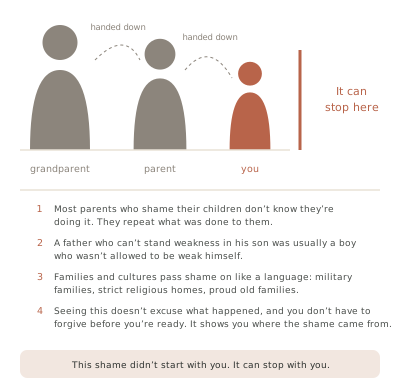
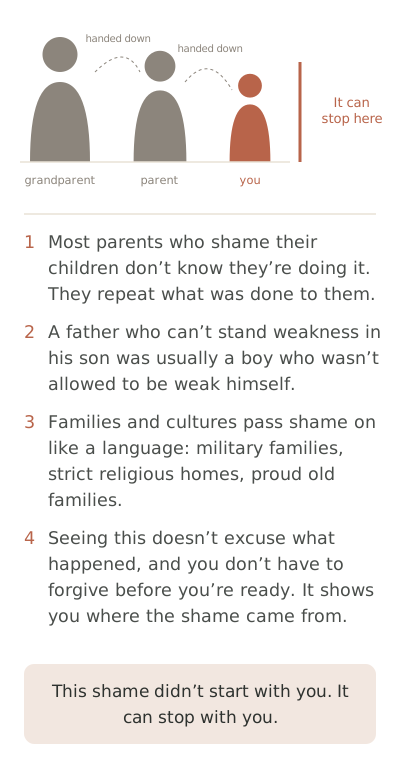
Most parents who shame their children don't know they're doing it. They repeat
what was done to them.
"Shame is not who you are. It is something you learned."
THE THREE SIGNS OF TOXIC SHAME
Toxic shame rarely says its own name. It shows up in three ways.
Most people know all three. Usually one is the loudest.
Sign One
The Voice
A mean voice that comments on everything you do. It sounds like you, so it's hard not to believe it. You fix one thing, and it finds the next.
Sign Two
The Freeze
Someone criticizes you, and suddenly you feel tiny, helpless, exposed. You feel like a small child again, even though you're an adult.
Sign Three
The Powerlessness
“I can't act. Nothing works for me.” It feels like a fact about you. It was learned, so it can change.
"I understand more, and
I felt the same."
There Is a Way Through
Understanding toxic shame doesn't make it go away. It changes when your nervous system has a new experience.
WHY I WRITE ABOUT THIS
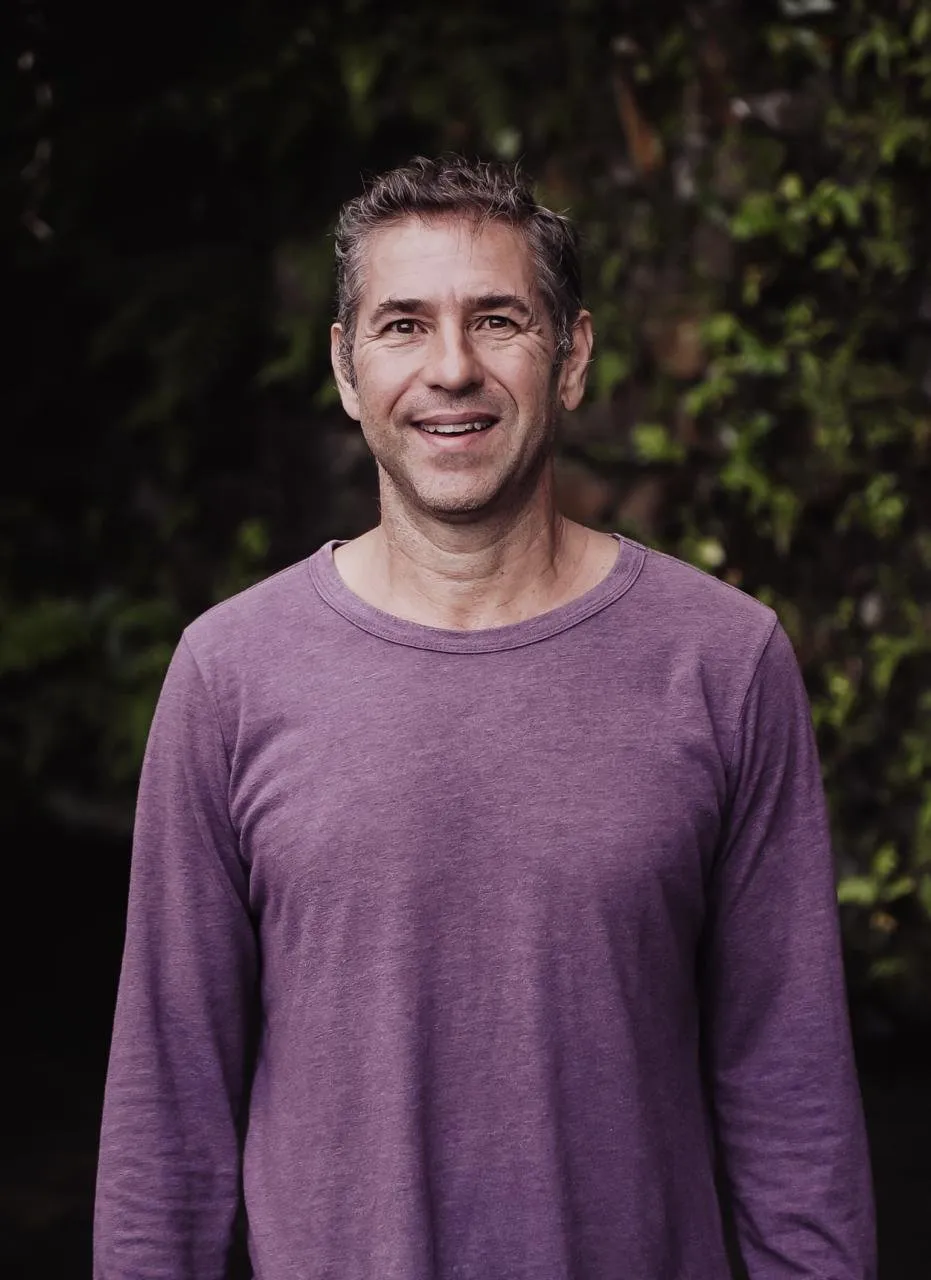
I'm Matteo Morozzo, a Somatic Experiencing Practitioner.
I carried toxic shame for most of my life. Therapy and
years of yoga didn't reach it. What changed it was working
with my nervous system.

START WITH THE BOOK
Healing Toxic Shame is a free book. Where shame comes from,
why understanding it wasn't enough, and what changes when you
work with your nervous system.
Free. It arrives in your inbox.
READY TO WORK WITH THIS DIRECTLY?
If you recognized yourself here, the next step is a First Session: 75 minutes of real somatic work, taken off your package if you continue.
HEAL TOXIC SHAME


© 2026 Matteo Morozzo · healtoxicshame.com